If you make regular financial contributions to charitable organizations and want to maximize the funds you already give, donating through a donor-advised fund (DAF) could be an option.
What is a DAF?
A DAF is a type of investment account that allows you to better support the charitable organizations you already support. It is a separate fund or account maintained and operated by a 501(c)(3) organization or the sponsoring organization.
Why use a DAF?
- A DAF may provide better returns than giving cash directly to a charity.
- Your donation is tax-deductible.
- The funds you gave to the charity can be invested and grow tax-free.
- You can set up recurring donations to make giving to the charity of your choice automatic.
Depending on the donor-advised fund, you can give cash, stocks, mutual funds, bonds and even cryptocurrency. You can donate to a non-profit organization and know that your generosity is helping the organizations you care about and that you’re helping make the most of the contributions they receive.
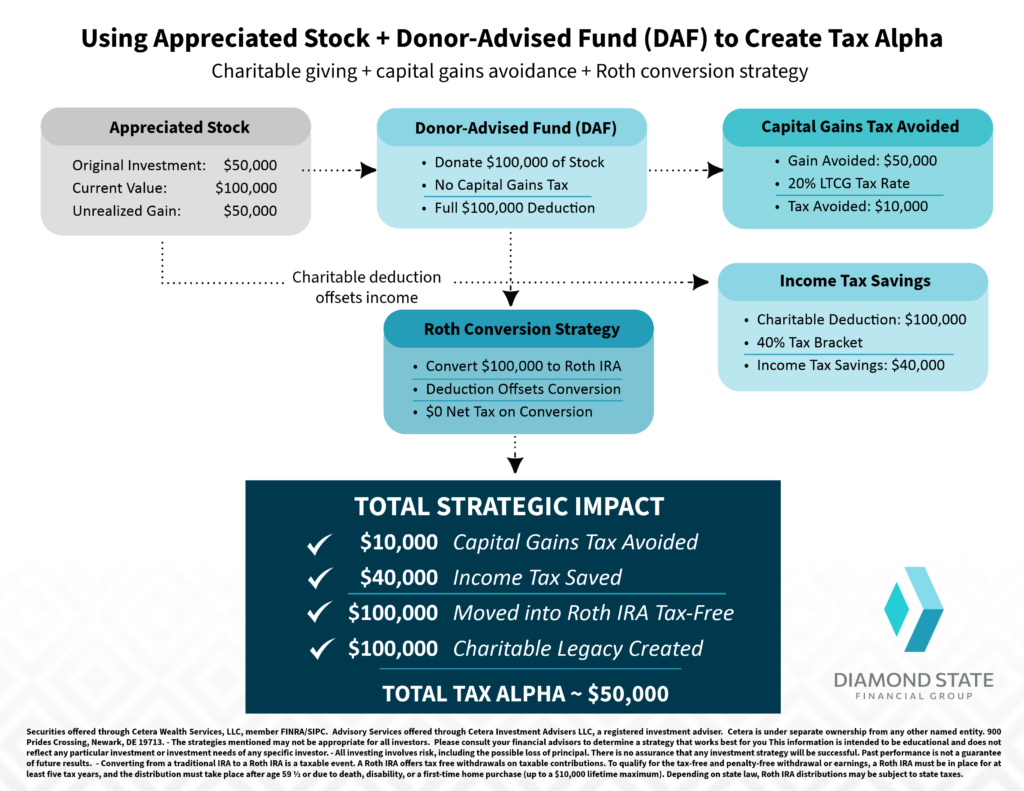
DAFs are a popular option for our clients who are interested in creating a charitable legacy and our advisors utilize them in many different scenarios. The diagram below shows how to use appreciated stock in conjunction with a DAF to help offset taxes and then use that tax alpha to put into a Roth IRA.
Is a donor-advised fund something that fits in with your larger financial goals of creating a charitable legacy? Fill out our Contact Form and an advisor will be in touch.
***
Generally, a donor advised fund is a separately identified fund or account that is maintained and operated by a 501(c)(3) organization, which is called a sponsoring organization. Each account is composed of contributions made by individual donors. Once the donor makes the contribution, the organization has legal control over it. However, the donor, or the donor’s representative, retains advisory privileges with respect to the distribution of funds and the investment of assets in the account. Donors take a tax deduction for all contributions at the time they are made, even though the money may not be dispersed to a charity until much later.